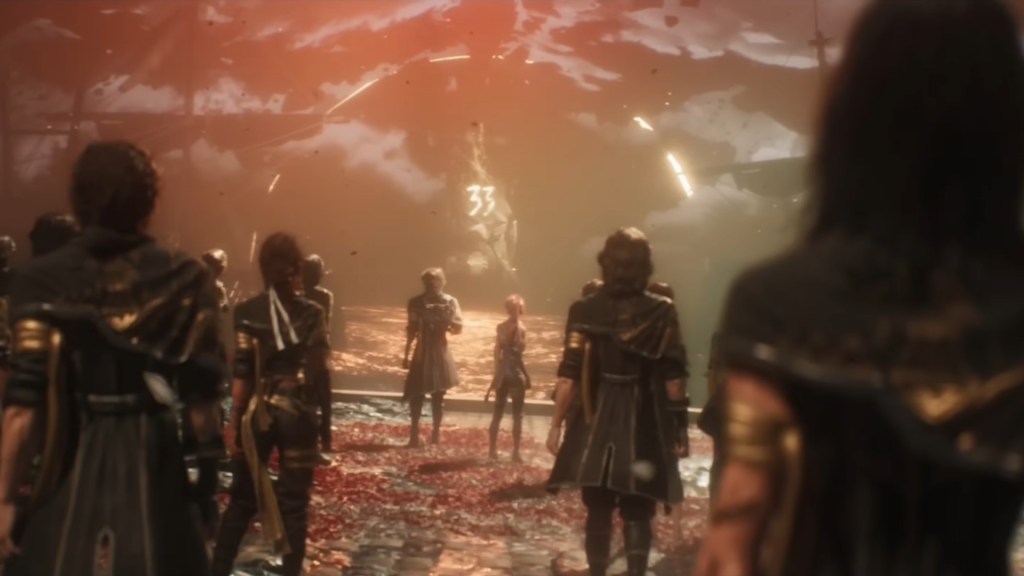
i’m about 20 hours into surprise game of the year contender clair obscur: expedition 33, but can’t stop thinking about a moment from much earlier in the game and how it loosely relates to conversations about passive violence in real life.
clair obscur: expedition 33 follows the inhabitants of the city of lumière. the belle époque-style metropolis sits isolated on a small island in the middle of a vast sea after being separated from the rest of the world six decades prior to the start of the game during an unexplained cataclysm known as the fracture. and if that wasn’t enough, lumière is also subjected to the gommage, an annual phenomenon that erases everyone above a certain age from existence. after every culling, the people of lumière prepare an expedition made up of soon-to-be-gommaged explorers to travel across the sea in the hopes of confronting the paintress, a giant woman who seemingly controls the catastrophe by lowering a giant, glowing number indicating the affected ages by one every year. none have succeeded thus far, but that doesn’t stop expedition 33 — aka the party you’ll control for much of the game — from following in the footsteps of their predecessors.
after a mysterious stranger brutally reduces expedition 33 to a fraction of its strength almost immediately upon its ship making land in foreign territory, team leader gustave and his adopted sister maelle reconnect during a brief moment of peace within the squad’s makeshift camp. maelle is suffering from nightmares brought about by her team’s decimation and shares the toll this trauma is taking on her mental health with gustave, who attempts to comfort her in anticipation of the difficult mission ahead.
Maelle: Being out here isn’t what I expected.
Gustave: As expected.
G: Hey, you okay?
M: Death out here’s not like death in Lumière, is it?
M: I— uh, I thought I was used to losing people.
M: Life of a foster child, right?
M: But not— not like that— on the beach… that man…
G: Yeah… yeah, I know…
G: Nevrons, we were prepared for, but not…
G: And now, we finally found other survivors and it’s…
G: You know that’s… that’s the insidious thing about the Gommage.
G: It’s… predictable. Almost gentle. It makes Lumiere complacent and accepting but…
G: The Gommage is equally violent and death… Death is just as final.
as horrifying as it is, the gommage is also objectively beautiful. its victims crack and fall apart like fibrous porcelain before diffusing into a flurry of petals, leaving behind gorgeous floral arrangements that belie the fact hundreds of human beings were just erased from existence. compared to the bloody massacre exacted against expedition 33 near the beginning of its journey, the gommage is downright peaceful. “almost gentle,” as gustave puts it. as such, lumièrians like maelle easily lose sight of the violence at the heart of the gommage in its layers of quiet inevitability. while the dread of its approach is palpable, it manages to erase friends, family, lovers, entire generations with barely more evidence to its existence than the soft whisper of a passing breeze. when the 16-year-old maelle refers to the 32-year-old gustave as an old man, it’s less about being a smart-ass teenager and more because he’s literally one of the the oldest people in lumière.
it wasn’t until maelle accompanied expedition 33 to the uncharted lands surrounding the paintress‘ domain and saw the majority of her fellow explorers cut down by an unknown enemy that she remembered the true horrors of death. the gommage‘s serene flower petals were replaced by gallons of blood and piles of lifeless bodies left in the massacre’s wake. passive violence may fade into the background with time, but active violence is in your face. it lingers. it shakes you from reverie and back into the real world. it haunts your sleep with nightmares and turns every waking moment into a fight against spiraling trauma. it demands your attention. and that can be terrifying when you’ve become complacent, especially outside the confines of a mere video game.
a 2020 study by researchers at yale university, the university of florida, and the university of maryland found that at least 68,000 people die in the united states each year due to lack of health insurance. and even if someone does manage to afford insurance, they then face the uphill battle of actually getting companies to pay for necessary care. unitedhealthcare, the largest health insurance provider in the united states, historically denies twice as many claims as the industry average. in 2019, the company denied 8.7% of post-acute care claims. in 2021, longtime unitedhealthcare chief financial officer brian thompson was promoted to chief executive. in 2022, the company denied 22.7% of post-acute care claims.
on december 14, 2024, a masked gunman shot and killed thompson outside the new york hilton in midtown manhattan. cartridge cases left behind after the shooting were labeled “delay,” “deny,” and “depose,” echoing a well-known insurance industry strategy for avoiding valid claimant payouts known as “delay, deny, defend.” five days later, local police arrested 27-year-old luigi mangione at a mcdonald’s in altoona, pennsylvania, and to this day he remains in custody as the manhattan district attorney‘s chief suspect in thompson‘s killing. since then, mangione has become something of a folk hero among mostly young, mostly left-leaning americans fed up with the insurance industry’s stranglehold on the country’s healthcare.
“i do apologize for any strife of [sic] traumas but it had to be done,” mangione allegedly explained in a written statement found among his belongings. “frankly, these parasites simply had it coming. a reminder: the US has the #1 most expensive healthcare system in the world, yet we rank roughly #42 in life expectancy. united is the [indecipherable] largest company in the US by market cap, behind only apple, google, walmart. it has grown and grown, but as [sic] our life expectancy? no the reality is these [indecipherable] have simply gotten too powerful, and they continue to abuse our country for immense profit because the american public has allwed [sic] them to get away with it.”

for whom do you think the american government and mass media held more contempt as this story unfolded? the pseudo-serial killer insulated from his crimes by several layers of bureaucracy or the one-time assassin who targeted him directly and avoided collateral damage? it’s been long enough now that i doubt you’ll need more than one guess. those in power were never going to say, “brian thompson deserved it,” but we who live in fear every day of having our lives upended by a single hospital bill were acutely aware of the desperation that allegedly drove mangione‘s actions and begged anyone with even a modicum of influence to acknowledge this fear. voters support democrats every two years, only to watch them continue to cozy up to the private insurance industry and ignore the growing popularity for single-payer or, at the very least, some sort of government-provided healthcare. “the lesser of two evils” is still evil, after all, so why react in horror when someone is driven by political inaction to take matters into their own hands?
“this is not to say that an act of violence is justified,” united states representative alexandria ocasio-cortez, one of the few politicians to speak on the moment without blanket condemnation towards those who understood mangione‘s supposed motives, told cbs news on december 12, “but i think for anyone who is confused or shocked or appalled, they need to understand that people interpret and feel and experience denied claims as an act of violence against them. people go homeless over the financial devastation of a diagnosis that doesn’t get addressed or the amount that they’re going to have to cover with a surprise bill. we kind of talk about how systems are violent in this country, in this passive way. our privatized healthcare system is like that for a huge amount of americans.”
much like the relationship between the people of lumière and the gommage in clair obscur: expedition 33, even those with a working understanding of the horrors of the united states‘ healthcare system tend to shuffle their feet in the face of the nigh-insurmountable mission that is trying to replace the mass murderers of private insurance with something better. mangione isn’t a revolutionary marxist or anarchist provocateur, but he saw an ill and sought to snuff it out the only way he knew how. when a gazelle is cornered by a pride of lions, the time for debate is over. it’s fight or die. mangione fought, killing a father and a husband, sure, but a father and a husband culpable for the deaths of hundreds of thousands of husbands and fathers — not to mention wives, mothers, sisters, brothers, aunts, uncles, friends, family, lovers, and maybe even entire generations. looking at the situation from that perspective, it’s a miracle thompson or someone like him wasn’t taken out sooner.
Is it not violent for a child to go to bed hungry in the richest country in the world? I think that is violent. But that type of violence is so institutionalized that it becomes a part of our way of life. Not only do we accept poverty, we even find it normal. And that again is because the oppressor makes his violence a part of the functioning society. But the violence of the oppressed becomes disruptive. It is disruptive to the ruling circles of a given society. And because it is disruptive it is therefore very easy to recognize, and therefore it becomes the target of all those who in fact do not want to change the society. What we want to do for our people, the oppressed, is to begin to legitimatize violence in their minds. So that for us violence against the oppressor will be expedient. This is very important, because we have all been brainwashed into accepting questions of moral judgment when violence is used against the oppressor.
Kwame Ture, “Stokely Speaks: From Black Power to Pan-Africanism,” 1965
 tell them i died
2 responses to “clair obscur: expedition 33’s gommage is the perfect example of passive violence”
[…] Final Fantasy VII Confronts Capitalism: Tifa Lockhart vs. Medical Debt | Sidequest Kathryn Hemmann delves into a Kazushige Nojima novel set in the FF7 Remake chronology to excavate a portrait of inevitable radicalization (Further Reading – Ian Walker links Clair Obscur‘s gommage to the US healthcare system). […]
LikeLike
[…] For Those Who Come After | Superjump Brandon R Chinn delves into Clair Obscur‘s meditations on death and life (Further Reading – Ian Walker on the US healthcare system and the gommage). […]
LikeLike